The JournalOwnership
Two Hundred Kilometres
The smallest motor in the three-wheeler range goes the furthest. That is not a paradox.
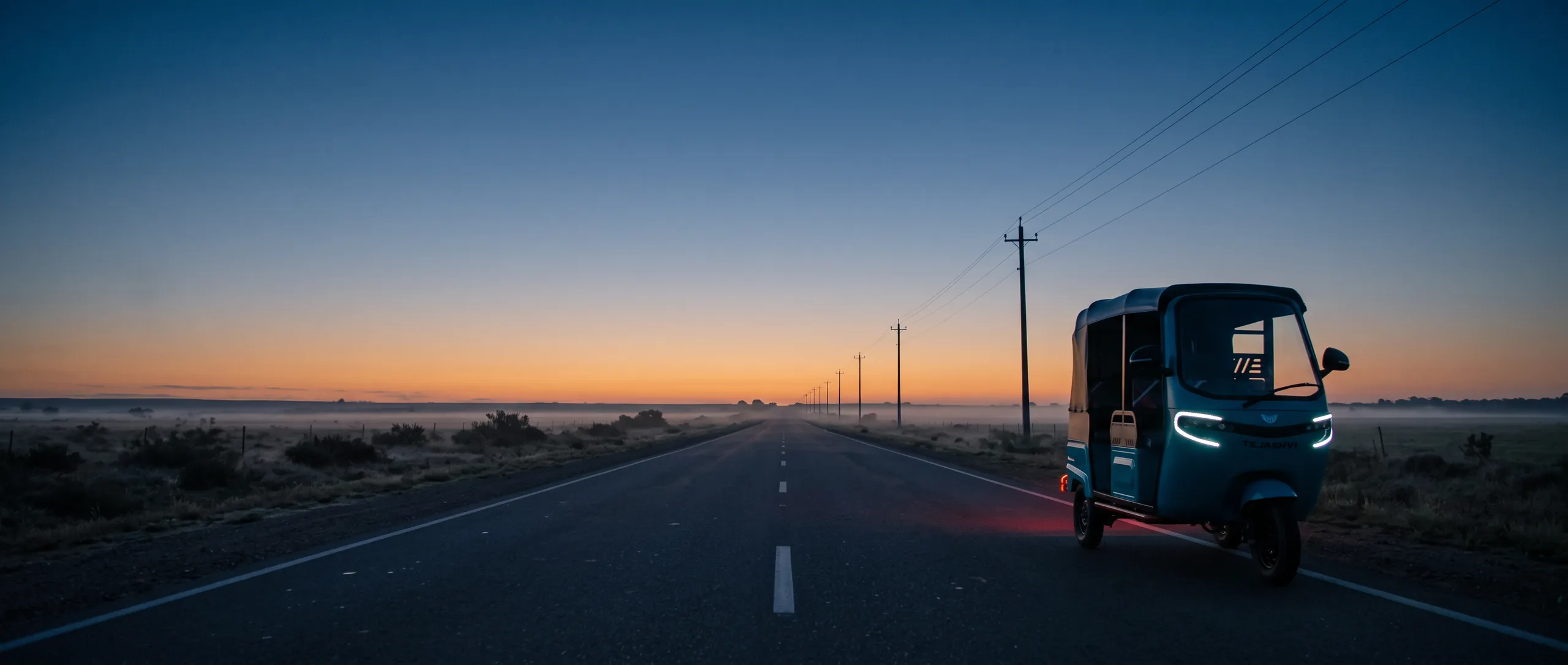
The TEJASHVI is the least powerful three-wheeler we build and it travels further on a charge than almost anything else in the range. Two hundred kilometres, from 1.74 kilowatts of peak power.
For a commercial driver, range is not a comfort feature. It is the length of the working day. Two hundred kilometres means the vehicle does not have to come home in the middle of it, and that is the whole argument.
- Battery
- Li-ion LFP, 10.2 kW
- Peak power
- 1.74 kW
- Range
- 200 km per charge
- Seating
- D + 4
- Carrying capacity
- 350 kg
- Charge time
- 7–8 hours
Why the bigger machines do not go proportionally further
The KALA GHODA and the LIMOSA are L5 vehicles built around PMSM motors with a great deal more power on tap — the KALA GHODA is rated at 8 kilowatts peak. It carries 18.2 kilowatt-hours and returns 220 kilometres; the LIMOSA carries 12 and returns 250. Set against the TEJASHVI, the KALA GHODA is hauling nearly twice the energy for one-tenth more distance.
Nothing is wrong with any of those numbers. An L5 spends its energy on speed and on payload — 550 kilograms in the KALA GHODA's case. An L3 peaking at 1.74 kilowatts and carrying 350 kilograms is asking its pack for far less, far more gently, all day, and gets a great deal more of its capacity back as distance.
Range is never a battery specification on its own. It is a battery, a motor and a top speed, arguing.
The 10.2 kilowatt decision
A 10.2 kilowatt-hour LFP pack at a modest voltage is a lot of amp-hours — the opposite of the high-voltage approach that buys speed on the DLX GOLD. Amp-hours are endurance. Given a motor that never asks for much at once, endurance is exactly what converts into distance.
Seven to eight hours, overnight
It charges in seven to eight hours, which is the number that actually matters: it fits inside the gap between the end of one shift and the start of the next. A vehicle that needs longer than a night to recover is a vehicle that loses a day.