The JournalEngineering
The Hub Motor, Explained
No gearbox, no chain, no clutch. One moving part and a great deal of copper.
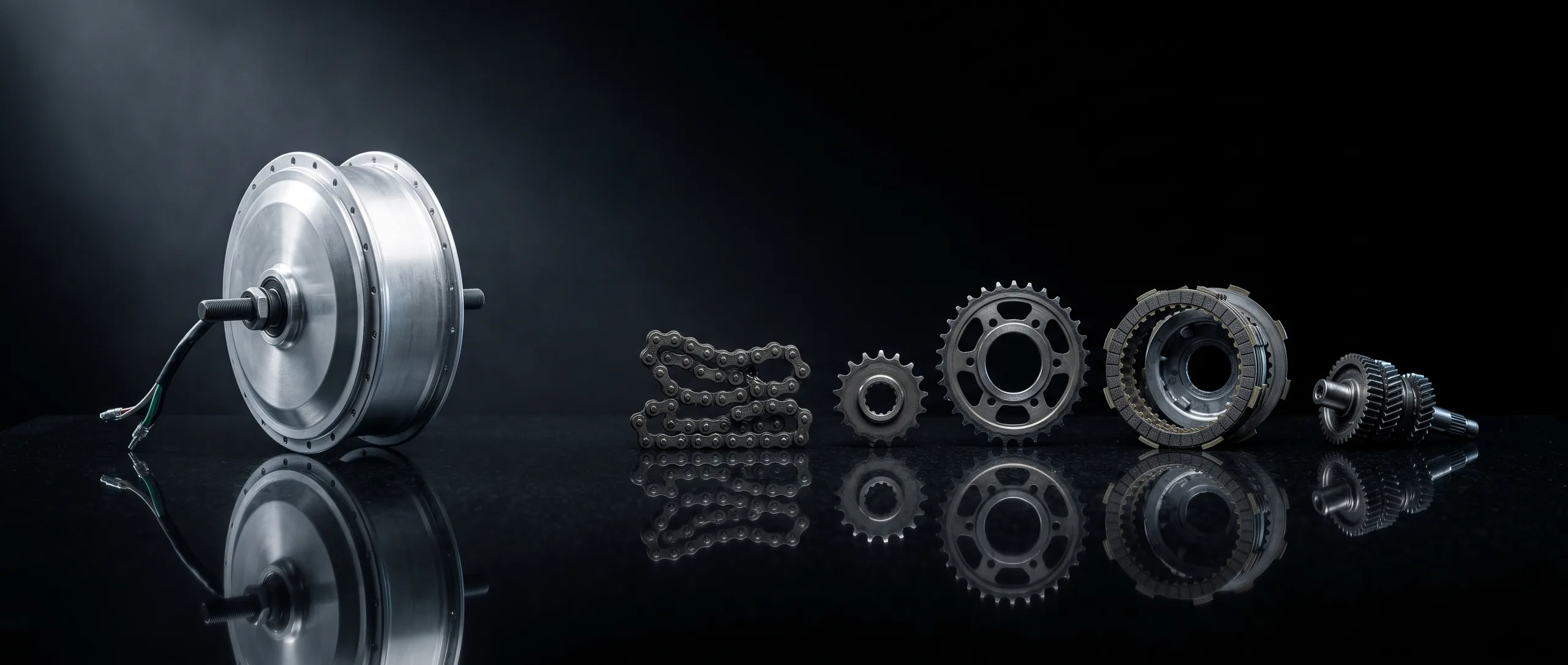
Take the engine, the gearbox, the clutch and the final drive out of a scooter. Replace all of it with a wheel that is also a motor. That is the whole idea.
Every Mercury two-wheeler in this range uses a BLDC hub motor — brushless direct current, built into the wheel itself. The EZ HIGHSPEED is rated at 1.2/1.5 kilowatts; the DLX (LS) and the DLX GOLD share the same architecture at their own settings.
Brushless means nothing is rubbing
An older brushed motor uses physical carbon contacts to switch current to the windings as it spins. They work, and they wear out, and they throw dust. A brushless motor does that switching electronically in the controller. Nothing touches. The only part that wears is the bearing.
The stator — the copper windings — is fixed to the axle. The magnets sit in the rotating shell of the hub. Energise the coils in the right sequence and the shell chases the magnetic field around. That shell is the wheel.
- MERCURY EZ HIGHSPEED
- BLDC hub, 1.2/1.5 kW, NMC 72/60/48 V, 2.5 kW
- MERCURY DLX (LS)
- BLDC hub, 3 kW Li-ion pack
- MERCURY DLX GOLD
- BLDC hub, lithium-ion pack
The efficiency argument for a hub motor is simple: there is no transmission to lose energy in, because there is no transmission.
What you give up
Unsprung mass. The motor is in the wheel, so the suspension has more weight to control over a bad surface. This is a genuine trade and it is why the suspension specification matters more on a hub-drive scooter than people assume — hydraulic telescopic forks and a double-shocker dual-tube arrangement on the EZ HIGHSPEED, a monoshock and a coiled spring absorber on the DLX GOLD.
You also give up the ability to change gearing. A hub motor is geared once, at the factory, forever. Which is why the top speed and the range figures are not separate decisions. They are the same decision, made once.